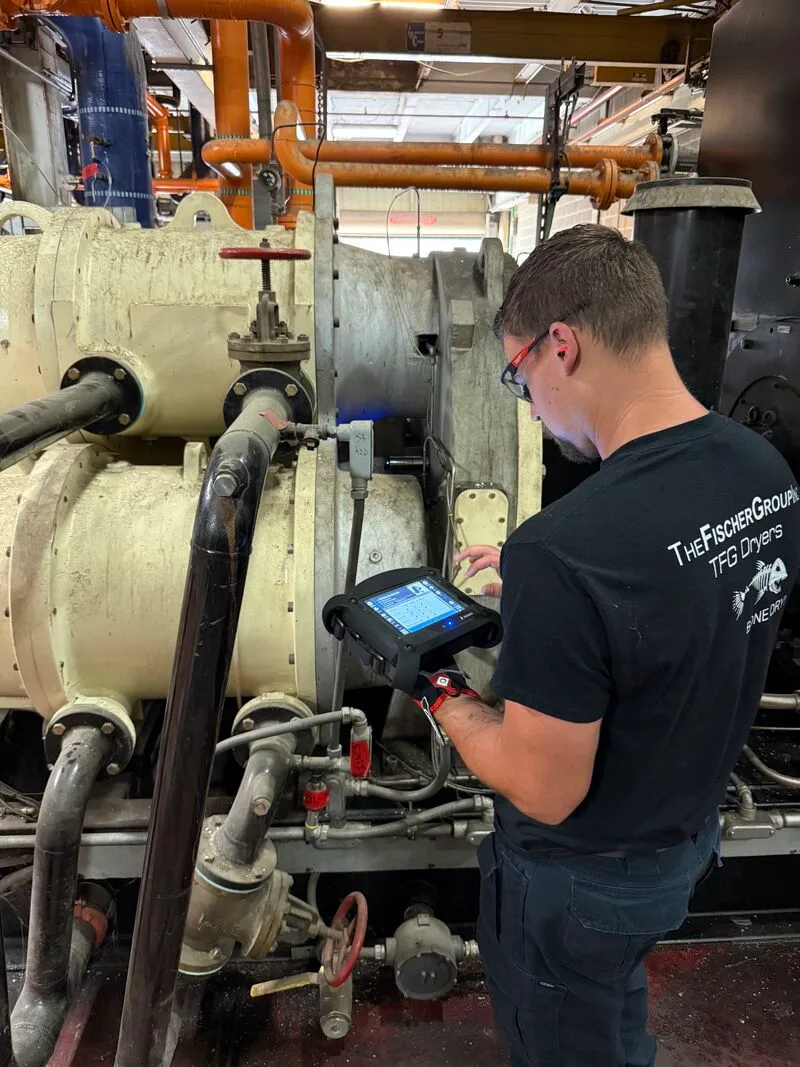
Each compressor stage
Every rotating assembly is measured on its own: first stage through the last, so a problem is located, not just detected.
Technical services · Vibration analysis
Advanced vibration analysis evaluates bearings, rotors, gears, alignment, mechanical looseness and imbalance on every rotating assembly, the drive motor and the gear train, so developing problems show up while they are still small.
What we measure
Every rotating assembly is measured on its own: first stage through the last, so a problem is located, not just detected.
Drive-end and non-drive-end readings on the main motor, which shares the gear train with the compressor.
Alignment-related signatures through the motor and bull-gear assembly, trended over time.
The compressor’s own vibration instrumentation is checked against independent field measurements.
What it tells us
From a recent assessment
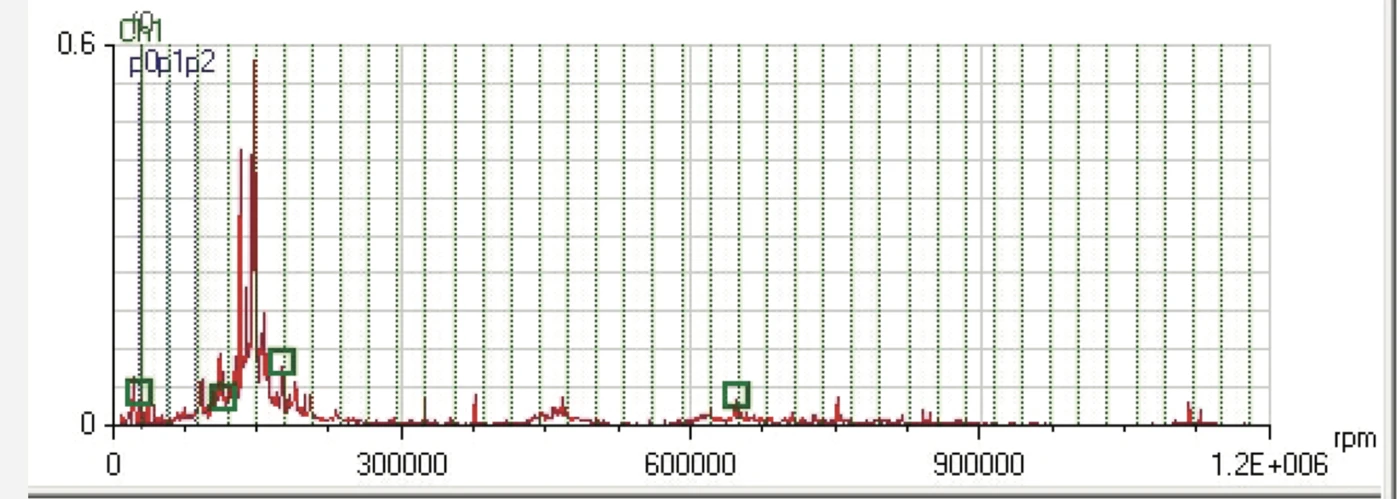
On one recent unit the first-stage spectrum was clean: low-amplitude components only, no running-speed harmonics, no bearing defect frequencies. The third stage told a different story, with a dominant peak at the fifth harmonic of stage running speed and a raised broadband noise floor around it.
The amplitudes were still under the alarm thresholds. But the spectral pattern, not the absolute amplitude, is what carries the information, so the recommendation was continued monitoring and a bearing inspection scheduled into the next planned outage.
What you receive
Vibration analysis is one of four disciplines read together in every condition assessment. One finding can be noise; several pointing the same way is a diagnosis.
The other disciplines
A condition assessment reads vibration, heat, oil and performance together and gives every machine a plain verdict.