Diagnostics
Compressor Life Is Measured, Not Assumed: Engineering-Based Condition Assessment
Age and operating hours do not tell you how much life a centrifugal compressor has left. Vibration analysis, thermal imaging, oil analysis and performance testing do.
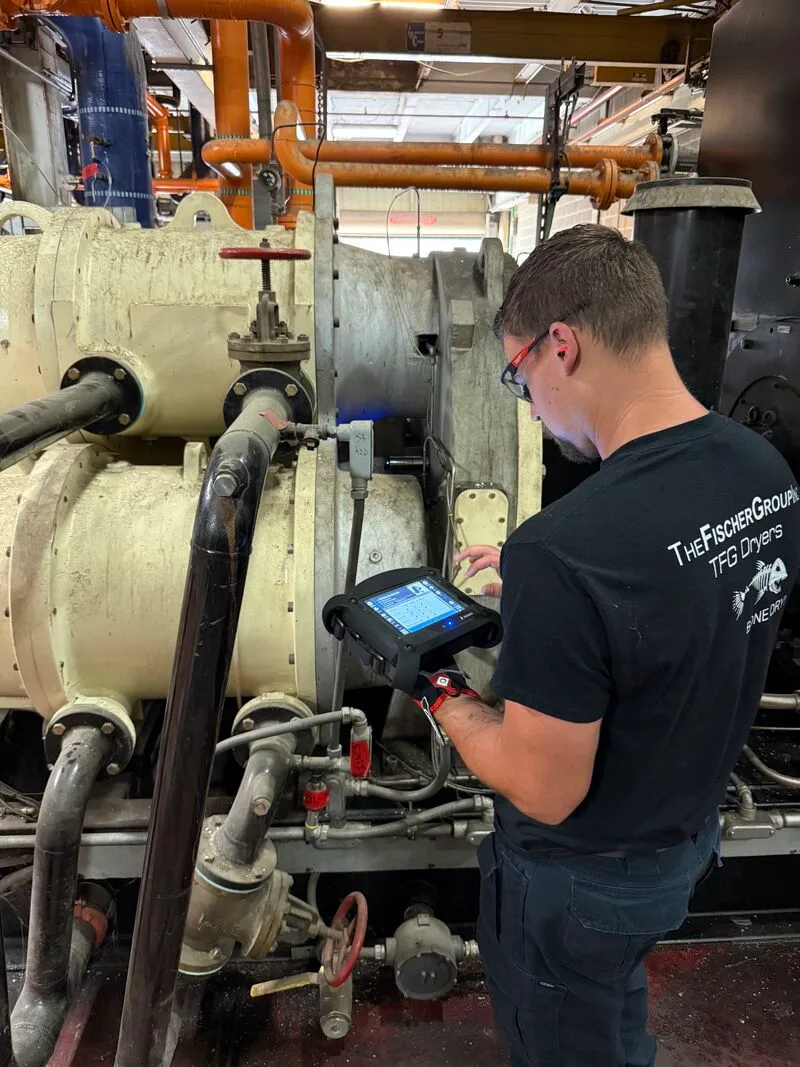
At The Fischer Group, we use established engineering technologies and proven diagnostic methods to determine the actual condition, operating efficiency and remaining service potential of centrifugal air compressors. Rather than relying only on calendar-based maintenance intervals or generalized life expectancies, we evaluate each compressor on measurable operating data and its actual mechanical condition.
No two compressors age the same way
Centrifugal air compressors do not share a common operating life. Operating hours, loading profile, starts and stops, ambient conditions, cooling efficiency, lubrication practices, contamination, surge events and maintenance history all have a significant effect on component life. That is why age and hours alone do not give an accurate picture of how much service a compressor has left.
Four disciplines, one assessment
Our condition assessment combines several diagnostic disciplines:
- Vibration analysis to evaluate bearings, rotors, gears, alignment, mechanical looseness, imbalance and developing mechanical problems.
- Thermal imaging to find abnormal heat, stage-to-stage temperature differences, bearing condition, and cooling or lubrication problems.
- Oil analysis to catch contamination, wear metals, oxidation, moisture and other signs of internal wear.
- Performance testing to measure actual operating characteristics, efficiency, pressure, flow and available operating margin.
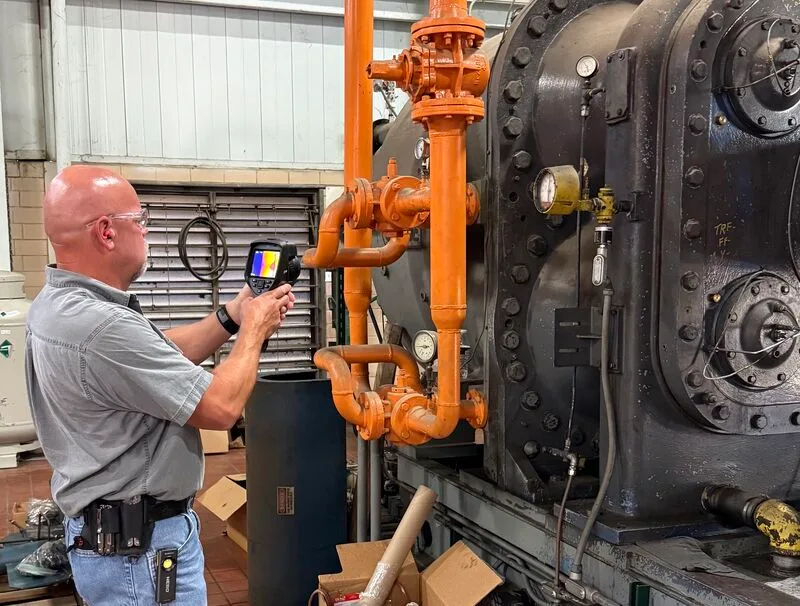
We look at each discipline on its own and then all of them together, with particular attention to vibration signatures, bearing and gear condition, stage temperatures, heat distribution, lubricant condition, and any departure from expected performance.
What the findings look like
A recent assessment shows why the disciplines belong together. The thermal survey of the compressor package showed no heat abnormalities, but it did point to an internal inspection. The vibration data filled in the detail. The first-stage rotating assembly was clean, with only low-level vibration and no signs of a developing fault. The third stage was a different story: a dominant peak at the fifth harmonic of running speed and a raised noise floor around it, which is consistent with the early stages of bearing wear.
The amplitudes were still below alarm limits, so nothing needed to stop. Our recommendation was continued monitoring and a bearing inspection scheduled into the next planned outage. That is the point of the work: the customer gets to fix a small problem on their own schedule instead of a large one on the compressor’s.
Condition over calendar
This condition-based approach lets us move past generalized life-cycle assumptions and give customers an engineering-supported view of equipment health and remaining service life. With it, we can find opportunities to extend equipment life, prioritize maintenance, avoid unnecessary capital spending, and address developing problems before they become production-critical failures.
Compressor life should be decided by condition, performance and measurable evidence, not simply by age.
Learn more about diagnostics and technical services and preventative maintenance programs, or contact The Fischer Group to schedule a condition assessment.